What Is a Glock Pistol? A Beginner’s Guide
Glock Pistol
Glock Pistol A Glock pistol is a semiautomatic handgun produced by Glock Ges.m.b.H., an Austrian firearms manufacturer. “Glock” is the company’s brand name, not a generic term for all pistols or handguns. The brand includes numerous models designed for different purposes and preferences, with variations in size, caliber, capacity, and other specifications. As a result, the name alone does not identify one particular configuration Glock Pistol.
Many Glock pistols are commonly associated with polymer frames and striker-fired mechanisms. A polymer frame uses a durable engineered plastic material for the main grip and frame structure, while a striker-fired design uses an internal spring-driven striker rather than an exposed hammer to initiate firing. These are broad characteristics, not a complete description of every detail or a guarantee that all models are identical. Features, dimensions, controls, and construction can differ by model and generation, so descriptions should be checked against the specific product.
The family is also known for a relatively consistent design philosophy across many models. Familiar elements may include similar layouts and operating concepts, even as individual pistols vary in scale and intended role. This continuity has helped make the brand widely recognizable among civilian owners, law-enforcement agencies, and military organizations. However, a common appearance or shared brand does not mean that models are interchangeable, nor does it establish that one model is suitable for every person or circumstance.
This guide provides general background to help readers understand what the term “Glock pistol” refers to and how the product family is described. It is not instruction in handling, operating, maintaining, or using a firearm. Firearms can cause serious injury or death, and anyone seeking practical information should consult qualified professionals, applicable laws, and the manufacturer’s official documentation. Safe storage and responsible decision-making are essential considerations whenever firearms are present.
Glock’s origins were not in firearms. Gaston Glock established his company in Austria in 1963, initially manufacturing products such as curtain rods and components for other industries. By the late 1970s, the company had experience working with polymers and precision manufacturing. When the Austrian military sought a new service pistol, Glock entered the competition despite having no previous experience producing handguns. The company assembled a team that included firearms specialists and used the military’s requirements to guide development.
The resulting pistol, later known as the Glock 17, was evaluated alongside competing designs in the early 1980s. After testing, the Austrian armed forces adopted it in 1982 under the designation P80. Its selection reflected a combination of practical factors, including reliability, manageable weight, capacity, and ease of manufacture, rather than one isolated feature. The model’s name referred to its 17-round magazine capacity, a relatively high figure for a standard service pistol of that period.
The Glock 17 brought together elements that already existed in firearms design, including polymer components and striker-fired mechanisms. Its importance lay in how the company combined these features with a durable steel slide, a simplified parts arrangement, and production methods suited to large-scale manufacturing. The pistol helped make polymer-framed, striker-fired handguns more familiar to military and law-enforcement buyers. Its success also encouraged other manufacturers to develop comparable service pistols, though the broader shift resulted from multiple companies and changing operational needs.
Following the initial military adoption, Glock expanded its range with pistols in different sizes, calibers, and configurations. Law-enforcement agencies adopted models in many countries, while civilian customers gained access to versions intended for personal ownership and target use. The company also developed competition-oriented models and accessories. This range allowed Glock to serve distinct markets while retaining a recognizable operating approach. Its historical influence is therefore best understood as the impact of a well-executed package—materials, mechanism, and manufacturing choices—that brought an alternative service-pistol design into widespread use.
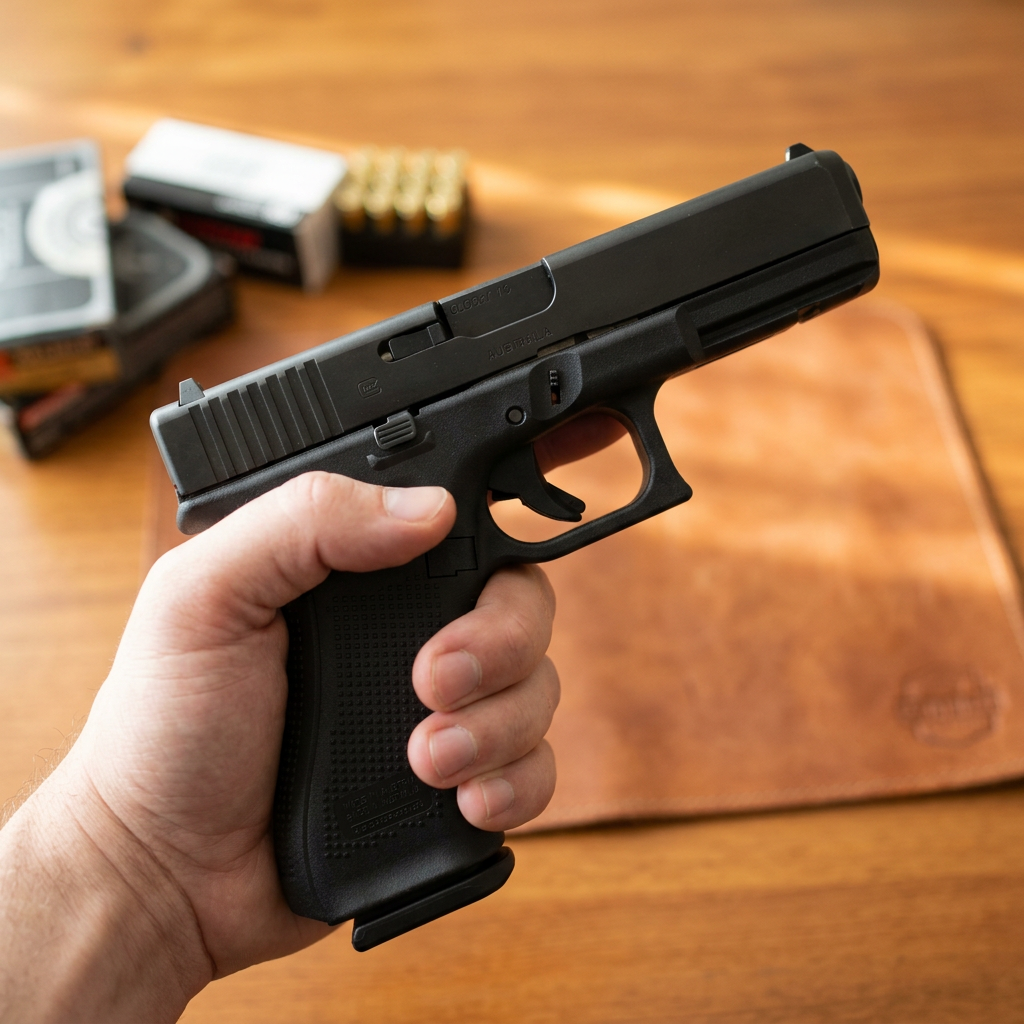
A Glock pistol is made up of several visible components that work together as a complete firearm. Knowing their names can help readers understand product descriptions, safety information, and basic diagrams. This is a visual overview only; it does not explain how to disassemble, load, or fire a pistol. Safe handling should always follow the manufacturer’s instructions and applicable laws.
The frame is the main lower body of the pistol. It supports the grip and carries controls, including the trigger and the magazine well. On many models, the frame is made from a durable polymer. Its shape and dimensions influence how the pistol feels in the hand, while details such as control placement can vary across models.
The slide is the prominent upper component. It houses or supports several parts and moves as part of the pistol’s operating cycle. The barrel sits within the upper assembly, with its opening visible at the front of the slide. Together, the slide and barrel form much of the pistol’s upper profile, although their precise design and dimensions depend on the model.
Sights are located along the top of the slide and provide visual reference points. Their style can differ: some pistols have simple fixed sights, while others may have different sight arrangements. The trigger is the curved control within the trigger guard. Its presence and appearance are easy to identify, but this description does not address its operation.
The magazine is a removable component that fits into the frame and holds ammunition. Magazine capacity and compatibility vary, so a magazine should never be assumed suitable based on appearance alone. The grip is the portion of the frame held by the user; texture, size, and contour can vary, affecting comfort and fit.
These parts provide a basic vocabulary for recognizing a pistol’s layout, not a complete technical explanation. Glock models differ in size, controls, and features, even when their overall appearance is similar. For identification, consult reliable manufacturer materials and check the exact model rather than relying on general descriptions.
“Striker-fired” describes a type of trigger and ignition system. Rather than using an exposed or internal hammer that swings forward to strike a firing pin, a striker-fired pistol uses a spring-driven striker housed within the slide. The trigger mechanism releases the striker, which then moves forward to initiate the cartridge. This is a broad design distinction, not a description of every detail: striker-fired systems differ among manufacturers and models in how components are partially or fully tensioned, and how their safeties are arranged.
Hammer-fired pistols, by contrast, use a hammer to deliver the impact that sets off a cartridge. The hammer may be visible externally or contained inside the frame, and hammer-fired designs encompass several different trigger arrangements. Neither category is inherently a complete measure of a pistol’s safety or suitability. Those depend on the particular model, its condition, its safeguards, and how it is handled. Understanding the terminology helps describe a design, but it does not replace instruction from a qualified source or careful attention to the manufacturer’s guidance.
A polymer frame is made from engineered plastic, not from an improvised or fragile material. It is designed to withstand the stresses involved in a firearm’s intended operation. In a typical Glock design, the frame is polymer, while the slide and many internal components are metal. Exact materials and construction details can vary by model and generation, so a general description should not be treated as a specification for every pistol.
Combining a polymer frame with metal components can support relatively low overall weight and resistance to corrosion in the frame, while allowing the slide and other parts to perform their structural and mechanical roles. A comparatively straightforward construction is another design goal often associated with these pistols. These choices also involve trade-offs: weight, grip shape, balance, trigger characteristics, and perceived recoil can feel different from one design to another, and personal preference matters. Polymer does not mean maintenance-free; routine inspection and care remain important, following the owner’s manual and applicable safety guidance. The specific materials, features, and handling characteristics should always be checked for the individual model.
Glock pistols are available in several model families, with designs intended for different roles and preferences. Models can vary in overall frame size, grip dimensions, slide and barrel length, magazine capacity, and other features. These differences affect how a pistol feels in the hand, how it fits a particular use, and how it is handled. A model’s name or family designation alone does not fully describe its dimensions or capabilities, so specifications should be checked for the exact version being discussed.
For a broad comparison, pistols are often described as full-size, compact, or subcompact. Full-size models generally have larger frames and longer barrels; compact models are typically smaller while retaining many features of a related full-size design; and subcompact models are generally shorter and more compact. These labels are useful general categories, not universal measurements. Glock model-specific dimensions, grip shape, and capacity can differ, including among versions that share a family name. Capacity also depends on the particular model and magazine, and may be subject to local laws.
Caliber refers to the cartridge a firearm is designed to use. Glock models are chambered for different cartridges, and ammunition is not interchangeable simply because it looks similar or shares a broad caliber label. Use only ammunition explicitly specified by the manufacturer for the exact pistol model, as indicated in its owner’s manual and markings. If the model or ammunition is uncertain, do not load or fire the firearm; consult the manual or a qualified professional. Correctly matched ammunition is one element of safe handling, alongside keeping the muzzle pointed in a safe direction, keeping the trigger finger outside the trigger guard until ready to fire, and treating every firearm as loaded. These general size and caliber distinctions can help readers understand model descriptions without implying that one category or cartridge is suitable for everyone. Safe storage and training remain important regardless of model.
Glock pistols may be encountered in several settings, though their presence and use vary by country, agency, and model. Some military and law-enforcement organizations issue particular Glock models to authorized personnel. In those roles, firearms are used under formal policies and procedures, with training, qualification requirements, secure storage rules, and legal accountability. Seeing a Glock associated with a police or military service does not mean every model is issued by every organization, or that professional practices automatically apply in other settings.
Where local law permits, private individuals may own Glock pistols for purposes such as lawful sporting participation, collection, or personal protection. Some owners encounter them at supervised ranges, training courses, or organized competitive events, where participants follow range rules and applicable regulations. Recreational and competitive shooting should take place only in appropriate, authorized environments, with safe handling practices and competent supervision. Laws governing purchase, possession, transport, storage, and use differ substantially across jurisdictions, so prospective owners need to check current local requirements rather than rely on general descriptions.
Whether a Glock—or any firearm—is suitable depends on the individual’s circumstances, the specific model, intended lawful use, relevant restrictions, and access to appropriate instruction. Physical comfort, ability to operate controls safely, secure storage arrangements, and willingness to maintain ongoing training can all matter. Familiarity with the Glock name, having seen one used by professionals, or understanding basic descriptions of its design is not the same as competence with a firearm. Safe handling requires practical instruction and consistent attention; it cannot be established through brand recognition alone. Firearm ownership or use is not appropriate for everyone, and choosing not to own or handle one is a valid decision. Anyone uncertain about legal obligations or safe practice should seek guidance from qualified local authorities or instructors before proceeding.
Safe firearm handling begins with a consistent set of rules, applied every time and regardless of whether a firearm is believed to be unloaded. Treat every firearm as loaded. Keep the muzzle pointed in a direction where an unintended discharge would be least likely to injure someone or cause damage, and remain aware of its direction while handling, moving, or setting it down. Never point a firearm at a person or anything you are not prepared to have struck.
Keep your finger outside the trigger guard and away from the trigger unless you are prepared to shoot in a lawful setting. When handling a firearm for inspection or practice, maintain this discipline even if you believe it is unloaded. Be certain of your target and what lies beyond it; a projectile can pass through a target or miss it, potentially striking people or objects out of view. If you are unsure about the surroundings, the firearm’s condition, or what a situation requires, stop and seek guidance rather than proceeding.
Secure storage is another essential part of responsible ownership. Store firearms so children and unauthorized people cannot access them, using a locked safe or other suitable locking device. Follow applicable laws and the manufacturer’s guidance, and consider keeping ammunition separately secured where appropriate. Storage arrangements should reflect the household and prevent access even when adults are nearby. Beginners should seek qualified, in-person instruction from a reputable instructor before handling or using a firearm. A professional can demonstrate safe practices, explain relevant laws, and correct unsafe habits in real time. Internal safety features may reduce certain risks, but they are not substitutes for careful handling, secure storage, or attention to these basic principles. Always assume that a safety mechanism can fail or be misunderstood, and follow the same precautions whether a mechanism appears engaged or not.
Firearm laws and regulations vary substantially among countries, states, provinces, and local communities, and they can change over time. Rules may address who is eligible to possess a pistol, how a purchase must be completed, whether registration or permits are required, and what restrictions apply to carrying or using a firearm. Requirements can also differ depending on the type of firearm, the owner’s circumstances, and the location where the firearm is kept or transported. General information about Glock pistols cannot establish which rules apply to a particular person or situation.
Before taking any action, consult current information from the relevant official government authorities, such as applicable national, regional, and local agencies. Confirm requirements for eligibility, purchasing, registration, transportation, storage, and permitted use directly with reliable sources. When the rules are unclear or circumstances are complex, seek advice from a qualified legal professional familiar with the relevant jurisdiction. A retailer, acquaintance, online discussion, or older publication may offer useful background, but should not replace authoritative guidance. Informal advice can be incomplete, inaccurate, or no longer current.
Responsible ownership also means preventing unauthorized access at all times. Learn and follow applicable safe-storage requirements, and consider how household members, visitors, or others might encounter the firearm. Use appropriate secure storage and keep access limited to people who are legally permitted and properly prepared to handle it. Do not assume that a familiar practice is lawful or safe everywhere, or that requirements remain unchanged after a move or change in circumstances. Verify the rules before purchasing, transporting, storing, or using a pistol, and revisit official guidance when regulations may have changed. Careful verification and professional advice help owners make informed decisions while respecting both legal obligations and the safety of others.
Are all Glock pistols the same? No. Glock offers multiple models, and their dimensions, intended roles, features, and generations differ. A compact model may be sized differently from a full-size one, while revisions across generations can change details such as grip texture or controls. Names and appearance alone may not reveal every distinction. Anyone considering a particular pistol should verify its exact model and generation using reliable manufacturer information, rather than assuming that guidance for one Glock applies to every other model.
Does “Glock” refer to a particular caliber? No. Glock is a manufacturer and brand, not the name of a single cartridge. Its pistols are chambered for various cartridges, and the specific chambering depends on the model. Caliber labels and cartridge names can be confusing to newcomers, so check the markings and documentation for the exact firearm. Do not rely on a seller’s description, a familiar model name, or visual similarity when identifying ammunition compatibility.
Do built-in safety mechanisms mean careful handling is unnecessary? Absolutely not. Mechanical features are not a substitute for safe conduct, and no firearm should be treated as incapable of firing unexpectedly. Keep the muzzle pointed in a safe direction, keep your finger outside the trigger guard unless lawfully prepared to fire at an appropriate target, and treat every firearm as loaded until its condition has been verified safely. These basic principles apply regardless of brand, model, or advertised safety features. Beginners should learn and practice them under qualified supervision.
Where should a new owner learn more? Begin with the official owner’s manual for the exact model, since details and warnings may vary. A qualified firearms-safety instructor can provide structured, hands-on education and answer questions in context. Laws also differ by location and can change, so consult current local authorities or official government sources about ownership, transport, storage, and permitted use. A retailer, online discussion, or general guide cannot replace model-specific documentation or competent instruction. Understanding a pistol’s name and design is only a starting point; safety, lawful conduct, and informed judgment must come first. Glock Pistol