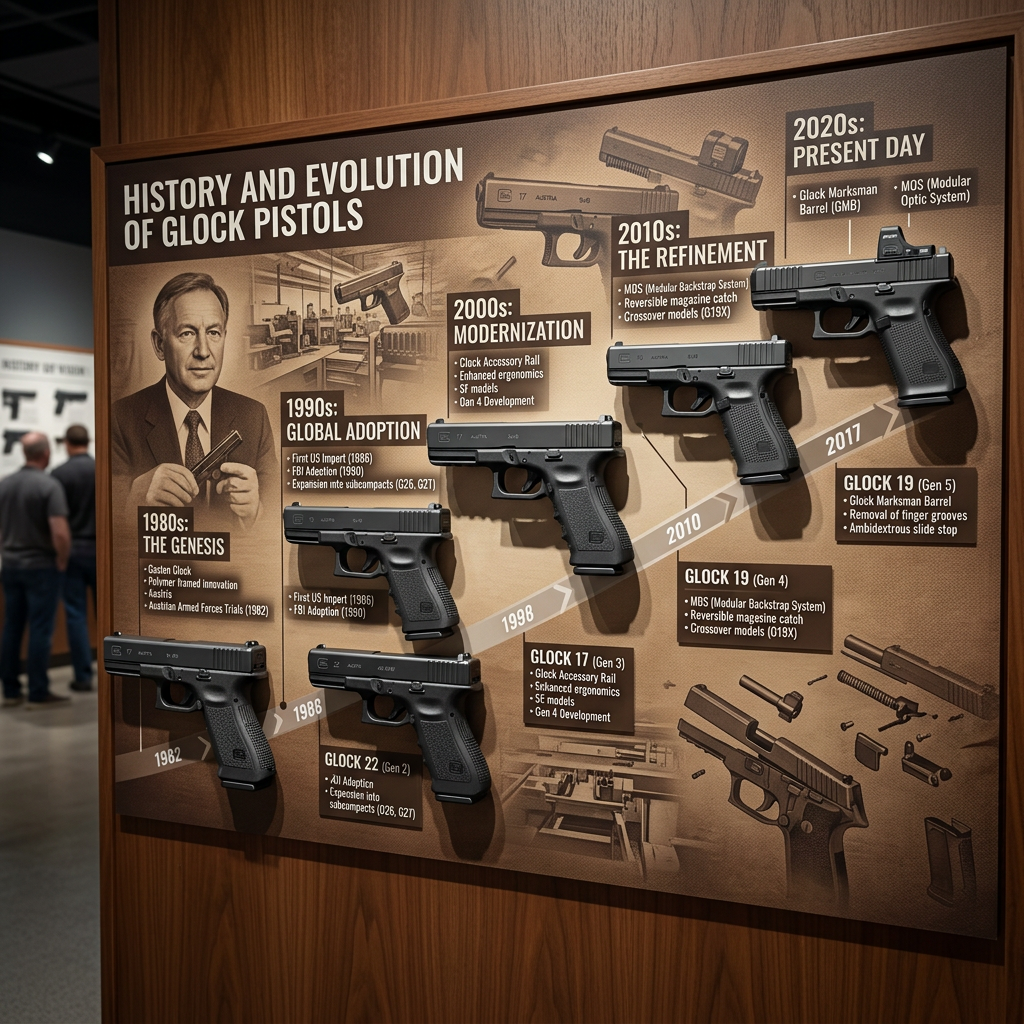
History and Evolution of Glock Pistols
History and Evolution of Glock Pistols
Introduction
Glock pistols have become an important part of modern firearm manufacturing history. Known for their distinctive polymer-frame construction and recognizable design, Glock handguns have influenced the development of modern semi-automatic pistols around the world.
The history of Glock began in Austria, where an engineer named Gaston Glock established a manufacturing company that would eventually become internationally recognized. Over the years, the company expanded its product range, introduced multiple generations of handguns, and developed models for different professional, sporting, and civilian markets.
Understanding the history and evolution of Glock pistols provides valuable insight into firearm engineering, Austrian manufacturing, and the technological changes that have shaped the modern handgun industry.
1. The Beginning of Glock
Glock’s history began in 1963 when Gaston Glock established his company in Austria. Initially, the business focused on manufacturing products made from metal and polymer materials.
The company later entered the firearms industry after responding to an Austrian military requirement for a new service pistol. This opportunity led to the development of the Glock 17, which became the foundation of the company’s internationally recognized handgun family.
The Glock 17 was adopted by the Austrian military in 1982. Its introduction marked a significant milestone in the company’s development and established Glock as an important name in modern firearm manufacturing.
2. The Introduction of the Glock 17
The Glock 17 is one of the most historically significant models in the company’s product lineup.
Its design incorporated a polymer frame, a steel slide, and a relatively simple mechanical architecture. At the time, the use of polymer materials in service pistols represented an important development in handgun manufacturing.
The Glock 17 helped establish the company’s recognizable design philosophy and became the starting point for numerous later models.
3. The Expansion of the Glock Product Family
Following the introduction of the Glock 17, the company expanded its product range to include different handgun sizes and configurations.
Some historically notable models include:
- Glock 19: A compact model introduced as part of the company’s expanding product family.
- Glock 20: Associated with the 10mm Auto cartridge.
- Glock 21: Part of Glock’s .45 ACP pistol history.
- Glock 22: Associated with the .40 S&W cartridge.
- Glock 23: A compact model in the .40 S&W category.
- Glock 26: A compact model introduced in the 1990s.
- Glock 34: A model associated with competitive shooting.
- Glock 42: Part of the Slimline product family.
- Glock 43: Another notable Slimline model.
- Glock 45: An example of Glock’s crossover design family.
- Glock 47: A later development in the company’s Gen5 product range.
These models illustrate how Glock expanded beyond its original handgun design and established a broad product family.
4. The Evolution of Glock Generations
One of the most important parts of Glock’s history is the development of its different pistol generations.
First Generation
The first-generation Glock pistols established the company’s original polymer-frame design philosophy. These early models helped introduce Glock to international firearm markets.
Second Generation
The second generation introduced design refinements and additional frame features. These changes reflected the company’s continued efforts to develop and improve its product range.
Third Generation
The third generation brought further changes to frame design and ergonomics. It became an important stage in the expansion of Glock’s international product family.
Fourth Generation
The fourth generation introduced additional ergonomic refinements and a revised frame design. It represented another major development in the company’s long-term manufacturing history.
Fifth Generation
The fifth generation introduced further changes to Glock’s product architecture, including refinements to frame construction, external design, and manufacturing details.
Each generation reflects the company’s continuing approach to product development and engineering improvement.
5. Glock’s Polymer-Frame Manufacturing Heritage
One of the most recognizable characteristics of Glock pistols is their polymer-frame construction.
The adoption of polymer materials represented an important development in modern firearm manufacturing. It demonstrated how manufacturers could use advanced materials as part of a different approach to traditional handgun construction.
Glock’s success helped make polymer-frame pistols a major category within the modern firearms industry.
The company’s manufacturing history is therefore closely connected with the wider development of polymer materials and modern handgun engineering.
6. Glock’s International Recognition
Over the years, Glock became an internationally recognized firearms manufacturer. Its products entered different markets and became part of discussions about modern handgun engineering and manufacturing.
The company’s development also illustrates the importance of international manufacturing, product standardization, and technological innovation.
Glock’s history is now studied as part of the broader development of modern semi-automatic pistols.
7. Glock’s Continuing Development
Glock continues to develop its product family through different models, generations, and design variations.
Its history demonstrates how an established manufacturer can maintain a recognizable engineering identity while introducing changes over time.
The company’s continued presence in the international firearms industry makes Glock an important subject for research into manufacturing history, material technology, and modern product development.
Conclusion
The history and evolution of Glock pistols represent an important chapter in modern firearm manufacturing. From the company’s establishment in Austria in 1963 to the introduction of the Glock 17 and the development of later generations, Glock has experienced significant growth and technological change.
Its polymer-frame manufacturing heritage, expanding product family, and generational developments have made the company an influential name in the history of modern handguns.
Studying Glock’s history helps readers understand how engineering, manufacturing materials, and product development have shaped the modern firearms industry.