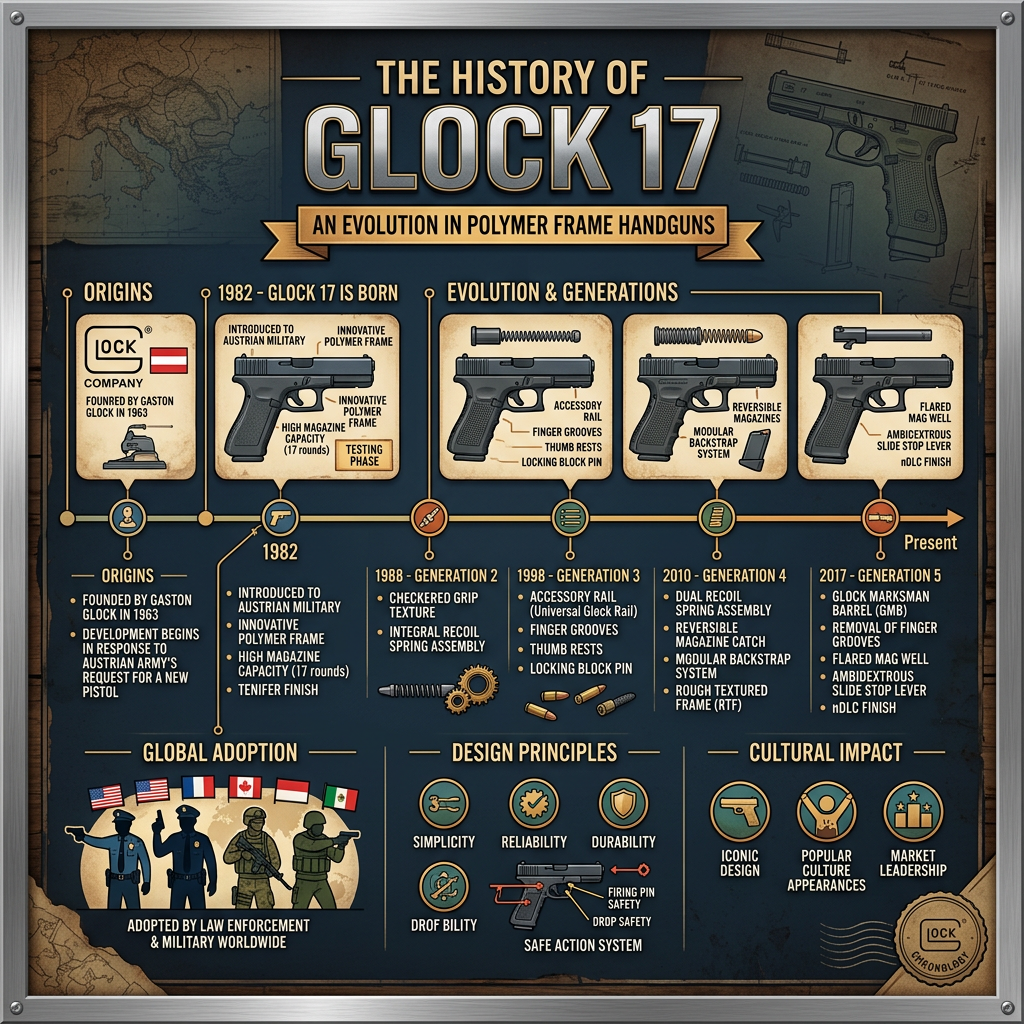
The History of Glock 17
The History of Glock 17: Origins, Development and Evolution
Introduction
History of Glock 17
The Glock 17 is one of the most historically recognized models in modern handgun manufacturing. Introduced by Austrian manufacturer Glock in the early 1980s, it became an important example of how new materials and engineering approaches could influence traditional handgun design.
The development of the Glock 17 began when the Austrian military sought a new service pistol. This requirement created an opportunity for Austrian engineer and manufacturer Gaston Glock to develop a completely new handgun platform.
From its early beginnings as the Glock P80 to its later international recognition, the Glock 17 has played an important role in the history of modern firearm manufacturing.
1. The Origins of the Glock 17
The story of the Glock 17 begins with Gaston Glock, an Austrian engineer and businessman who founded Glock KG in 1963.
Before entering the handgun industry, his company manufactured products using metal, wood, and polymer materials. During the 1970s, the company also became involved in producing military-related equipment.
In the early 1980s, the Austrian Ministry of Defense began looking for a new military service pistol. Gaston Glock recognized the opportunity and began developing a new handgun design that would meet the military’s requirements.
His work eventually led to the creation of the Glock P80, the original model that became known internationally as the Glock 17.
2. The Introduction of the Glock P80
In March 1982, Gaston Glock submitted prototype pistols for evaluation by the Austrian Armed Forces.
The design received considerable attention because it introduced a combination of polymer-frame construction and Glock’s newly developed Safe Action system.
After completing the military evaluation process, the Glock design emerged as the successful candidate.
In 1982, the Austrian Army accepted the pistol as its new service handgun. Between 1982 and 1984, more than 25,000 first-generation pistols were delivered to the Austrian Armed Forces.
The original P80 later became known as the Glock 17.
3. Why Is It Called the Glock 17?
The name Glock 17 is closely associated with the pistol’s original development and identity.
According to Glock’s official historical account, the designation corresponded to the pistol’s 17-round magazine capacity.
This naming became part of the model’s identity and helped establish the naming convention associated with the company’s early handgun lineup.
4. International Recognition
Following its adoption by the Austrian military, the Glock 17 began attracting international attention.
In 1984, Norway selected the pistol as its standard military sidearm, marking an important step in Glock’s international expansion.
The company also began developing relationships with law enforcement and military organizations in other countries.
In November 1985, Glock established its American subsidiary, Glock, Inc., in Smyrna, Georgia. This development helped introduce the brand to a much larger international market.
The Glock 17 subsequently became one of the most recognizable products in the company’s history.
5. The Engineering Heritage of the Glock 17
The Glock 17 is historically significant because of its contribution to the development of polymer-frame handguns.
Its original design combined a polymer frame with metal components and a distinctive internal safety system.
Glock’s manufacturing philosophy emphasized simplified construction, consistent production methods, and the use of modern materials.
The introduction of this design helped demonstrate the potential of polymer materials in modern handgun manufacturing.
6. The Evolution of Glock 17 Generations
Over the years, the Glock 17 developed through several generations.
First Generation
The first-generation Glock 17 established the original design identity of the model. It introduced the polymer-frame platform that became central to the company’s manufacturing heritage.
Second Generation
Introduced in 1988, the second generation included changes to the frame design and grip texture. It represented an early refinement of the original pistol platform.
Third Generation
Introduced in 1998, the third generation brought additional external design changes, including an accessory rail and revised frame features.
Fourth Generation
Introduced in 2009, the fourth generation included ergonomic refinements and a modular backstrap system.
Fifth Generation
The fifth generation introduced further design developments, including changes to frame features, external controls, and manufacturing details.
Sixth Generation
The sixth generation represents a newer chapter in Glock’s development, with its global launch taking place in 2026. It demonstrates the company’s continuing interest in updating its established product platform.
7. The Glock 17’s Place in Modern Firearm History
The Glock 17 represents an important turning point in the history of modern semi-automatic pistols.
Its development demonstrated how established manufacturing principles could be combined with new materials and engineering concepts.
It also helped establish Glock as an internationally recognized firearms manufacturer.
The model’s history is closely connected with the wider development of polymer-frame technology, military procurement, and modern handgun manufacturing.
Conclusion
The history of the Glock 17 began in Austria during the early 1980s, when Gaston Glock developed a new service pistol for the Austrian Armed Forces.
From its original identity as the P80 to its international recognition as the Glock 17, the model became an important part of modern firearm manufacturing history.
Its introduction, international adoption, and development through successive generations demonstrate how engineering innovation and manufacturing technology can influence an entire industry.
Today, the Glock 17 remains an important subject for anyone studying Austrian manufacturing, polymer-frame technology, and the evolution of modern handguns.