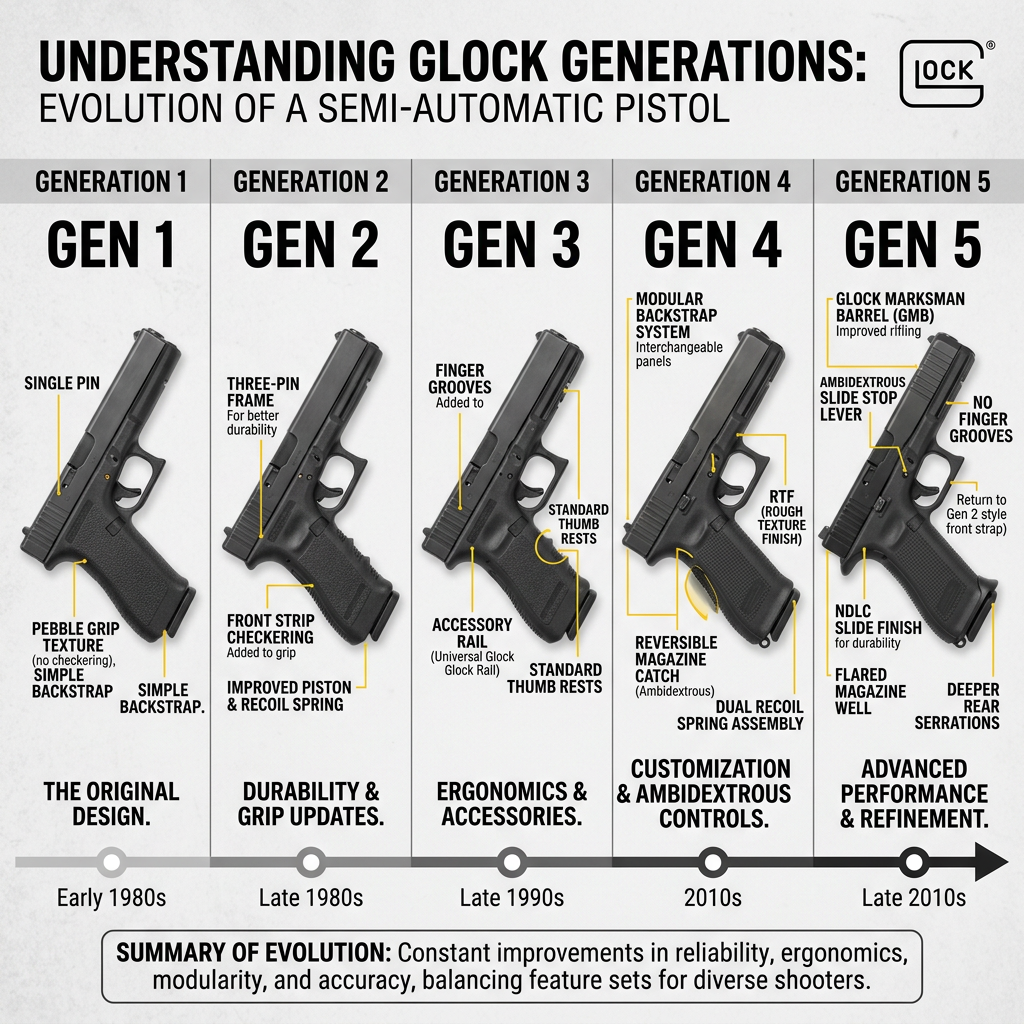
Understanding Glock Generations
Understanding Glock Generations: A Complete Guide to Their Evolution
Introduction
Glock pistols have become an important part of modern firearm manufacturing history. Since the introduction of the original Glock 17 in the early 1980s, the Austrian manufacturer has continued developing its handgun designs through several generations.
Each Glock generation represents a stage in the company’s engineering and manufacturing development. Over time, changes have included frame design, ergonomics, surface finishes, internal components, and other manufacturing refinements.
Understanding Glock generations helps readers recognize how the company’s products have evolved and how modern handgun engineering has changed over the years.
1. What Are Glock Generations?
Glock generations are groups of pistol designs that share particular manufacturing and design characteristics.
The generation system helps distinguish different stages in the development of Glock pistols. Although the overall design philosophy has remained recognizable, individual generations have introduced various refinements.
The main generations commonly discussed in Glock’s history are:
- Generation 1
- Generation 2
- Generation 3
- Generation 4
- Generation 5
- Generation 6
These generations represent different periods in the company’s product development.
2. First Generation Glock Pistols
The first-generation Glock pistols appeared in the early 1980s, beginning with the Glock 17.
These early models established the company’s recognizable polymer-frame construction and distinctive design approach.
The first generation is historically important because it introduced Glock’s original handgun platform to the international firearms industry.
Its development marked the beginning of a product family that would later expand into numerous models and configurations.
3. Second Generation Glock Pistols
The second generation represented an important stage in the refinement of Glock’s original designs.
This generation introduced changes to frame features and external construction. These developments reflected the company’s ongoing efforts to refine its manufacturing approach.
Second-generation pistols remain an important part of Glock’s historical product lineup because they demonstrate the transition from the original design into a more developed product family.
4. Third Generation Glock Pistols
The third generation brought additional design developments to the Glock product family.
One of its recognizable historical features was the introduction of finger grooves and additional external frame features on many models.
This generation also reflected continued changes in manufacturing and product standardization.
Third-generation pistols became widely recognized and represent an important period in the company’s international expansion.
5. Fourth Generation Glock Pistols
The fourth generation introduced further refinements to Glock’s handgun designs.
One of the most recognizable changes was the introduction of a modular backstrap system on many models. The generation also included updates to frame texture and other design characteristics.
These developments reflected the company’s continued interest in improving product ergonomics and adapting its established engineering platform.
The fourth generation marked another important stage in the evolution of Glock pistols.
6. Fifth Generation Glock Pistols
The fifth generation introduced several notable design changes across the Glock product family.
Many Gen5 models feature a revised frame design, an ambidextrous slide stop, and a flared magazine well. Finger grooves found on many earlier models were removed.
The fifth generation reflects a period of further refinement in Glock’s manufacturing and product design history.
Models associated with this generation include the Glock 17 Gen5, Glock 19 Gen5, Glock 26 Gen5, and other Gen5 variations.
7. Sixth Generation Glock Pistols
The sixth generation represents a newer chapter in Glock’s product development, with its global introduction taking place in 2026.
It demonstrates the company’s continued efforts to update its established handgun platform and respond to developments in modern manufacturing and product design.
Because this is a recent generation, readers should consult official Glock announcements for the latest model availability and specifications.
8. Major Differences Between Glock Generations
Although all Glock generations share a recognizable design heritage, they differ in several areas.
Some of the main areas of development include:
Frame Design: Different generations introduced changes to frame features, texture, and overall external construction.
Ergonomics: Later generations included refinements intended to improve the overall design and handling characteristics.
Manufacturing: Glock continued updating production methods and components throughout its history.
External Features: Changes to finger grooves, slide controls, and other visible characteristics help distinguish certain generations.
Product Development: Each generation reflects the company’s efforts to maintain its established engineering philosophy while introducing new design developments.
9. Why Glock Generations Matter
Understanding Glock generations is useful for firearm historians, collectors, researchers, and anyone interested in modern manufacturing technology.
The generations provide a way to study how an established product platform changes over time.
They also demonstrate the importance of engineering improvements, material development, and manufacturing consistency in the modern firearms industry.
Conclusion
The evolution of Glock generations represents an important part of modern handgun manufacturing history.
From the original first-generation Glock 17 to the latest sixth-generation developments, the company has continued refining its established product platform.
Each generation contributes to the wider history of Glock and demonstrates how manufacturing technology and product design have changed over several decades.
Understanding these generations provides readers with a clearer picture of Glock’s engineering heritage and its influence on modern firearm manufacturing.